
Loading BSGE...
bsge.bd.hgs@gmail.com +880 1324433238
BSGE Logo

Join the Society

Be part of a dynamic community driving innovation and sustainability in geotechnics. Whether you're a student, professional, or corporate, we offer opportunities for learning, collaboration, and growth. Shape the future of infrastructure with us!

Bangladesh Society for Geotechnical Engineering

The Bangladesh Society for Geotechnical Engineering (BSGE) is a professional organization dedicated to the advancement of geotechnical engineering in Bangladesh.

Latest Updates Urgent Notice Regarding Membership Renewal   |   Open Call for Corporate Membership Application   |   Call for New Membership Applications (Professional Members)   |   Notification Regarding Student Membership Opportunities   |   Call for Papers for Upcoming Journals and Publications   |   The Role of Subsurface Exploration in Modern High-Rise Construction   |   Advanced Ground Improvement Techniques for Weak Soils   |   Building Resilient Infrastructure: Geotechnical Adaptations to Climate Change   |   Journal of Geotechnical Engineering - Paper Format   |  

Welcome to BSGE

The Bangladesh Society for Geotechnical Engineering (BSGE) serves as a bridge between academics and practitioners in the field of soil mechanics and foundation engineering. We aim to foster innovation, ensure safety in infrastructure, and promote technical excellence across the nation.

Prof A. M. M. Safiullah

President, BSGE

"Warm greetings to BSGE members, well wishers and patrons. Thanks for your continued support in BSGE activities all through the years since formation of the society in 1989. I hope BSGE activities will be facilitated with this updated web page. Let's make it an effective means for communication and information sharing among our fellow members and geotechnical professionals/organizations at home and around the world. With the increase in infrastructure development in Bangladesh we have to face new geotechnical challenges in the coming years. I would request the civil engineers, academicians, contractors, geotechnical firms and all others relevant to the geotechnical engineering profession in the country for increased interaction through BSGE to develop and maintain standards so that we can face these challenges in a professional way."

Prof. S. J. M. Yasin

Secretary General, BSGE

"Welcome to the newly updated official portal of the Bangladesh Society for Geotechnical Engineering (BSGE). As the Secretary General, it is my absolute privilege to invite all our respected members, researchers, and industry professionals to actively engage with this digital platform. BSGE has always strived to bridge the gap between academic research and practical field applications. Through this website, we aim to streamline our membership services, easily share our publications, and keep you updated on upcoming seminars and workshops. I urge both young and experienced professionals to step forward, share their knowledge, and participate in our activities. Together, let us build a robust geotechnical community that significantly contributes to the sustainable and safe infrastructure development of Bangladesh."

Executive Committee

The leaders guiding the Bangladesh Society for Geotechnical Engineering.

Prof. A.M.M. Safiullah

Prof. A.M.M. Safiullah

President

Professor, Civil Engineering Dept., BUET

Prof. Md. Zoynul Abedin

Prof. Md. Zoynul Abedin

Vice-President

Professor, Civil Engineering Dept., BUET

Prof. S. J. M. Yasin

Prof. S. J. M. Yasin

Hon. Secretary General

Professor, Civil Engineering Dept., BUET
Dr. Md. Jahangir Alam

Dr. Md. Jahangir Alam

Treasurer

Professor, Civil Engineering Dept., BUET

Corporate Members

Our proud partners shaping the industry

News & Articles

News 07 May, 2026

Building Resilient Infrastructure: Geotechnical Adaptations to Climate Change

Climate change is introducing unprecedented challenges to civil and geotechnical engineering. Extreme weather events, changing groundwater levels, and increased coastal flooding directly impact the stability of soils and the foundations they support. As the climate evolves, so must geotechnical practices to ensure the resilience of our national infrastructure.

Prolonged droughts can cause expansive soils to shrink and crack, while intense rainfall can trigger severe slope instability and landslides. Geotechnical engineers are now tasked with designing embankments, retaining walls, and foundations that can withstand these extreme fluctuations. This includes developing advanced drainage systems, utilizing geosynthetics for soil reinforcement, and adopting sustainable earthwork practices. Future-proofing infrastructure requires a deep understanding of soil-water interactions and a proactive approach to risk management, making geotechnical expertise more vital than ever in the era of climate change.
News 07 May, 2026

Advanced Ground Improvement Techniques for Weak Soils

Urbanization often pushes construction into areas with challenging or weak soil conditions, such as soft clays, loose sands, or reclaimed lands. In such scenarios, traditional deep foundations can be economically unviable. This is where advanced ground improvement techniques come into play, offering innovative solutions to enhance the engineering properties of the in-situ soil.

Techniques such as jet grouting, pile base grouting, and pressure grouting have revolutionized the way geotechnical engineers approach weak soils. Jet grouting, for instance, uses high-velocity fluid jets to excavate and mix the soil with a cementitious binder, creating structural geometries directly underground. These methods significantly increase the soil's load-bearing capacity, mitigate settlement issues, and provide excellent groundwater control. By treating the soil rather than bypassing it, engineers can ensure long-term foundation stability while maintaining project efficiency and sustainability.
News 07 May, 2026

The Role of Subsurface Exploration in Modern High-Rise Construction

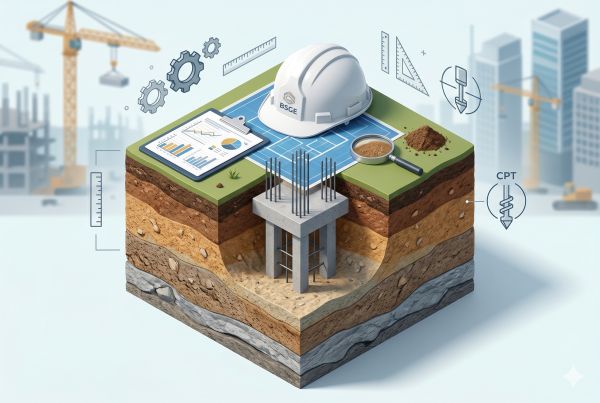
Subsurface exploration is the foundational step in any major construction project, particularly for high-rise buildings. Before a single brick is laid or concrete is poured, geotechnical engineers must understand the complex layers of soil and rock beneath the surface. This process involves drilling boreholes, conducting standard penetration tests (SPT), and extracting soil samples for rigorous laboratory analysis.

The primary objective is to determine the soil's bearing capacity, settlement characteristics, and the depth of the groundwater table. In earthquake-prone regions like Bangladesh, assessing the liquefaction potential of the soil is also critical. Without a comprehensive subsurface investigation, engineers cannot accurately design the foundation—whether it be shallow footings or deep pile foundations. Investing in thorough soil testing not only ensures the structural integrity and safety of the building but also optimizes construction costs by preventing over-engineering and avoiding unforeseen ground failures during or after construction.